
Views: 0 Author: Site Editor Publish Time: 2025-12-29 Origin: Site


Water bottles face a unique set of environmental stressors that most product packaging never encounters. From the moment a bottle leaves the filling line, it battles condensation, submersion in ice buckets, and constant friction during transport. For brand owners and manufacturers, this presents a critical challenge: a label that peels, wrinkles, or disintegrates destroys brand perception instantly. While many start by asking about paper, the harsh reality of the beverage industry is that standard paper is often the wrong tool for the job.
The term "paper" is frequently used as a catch-all for labeling material, but the industry standard has aggressively shifted toward durable synthetics like Vinyl and Biaxially Oriented Polypropylene (BOPP). Choosing the wrong substrate leads to wasted budget and damaged inventory. This guide evaluates the entire spectrum of labeling solutions, helping you navigate from DIY short-runs for events to industrial-scale automation for retail distribution. We will analyze material durability, adhesive chemistry, and the machinery required to apply these labels efficiently.
Condensation is the Enemy: Standard uncoated paper will disintegrate or wrinkle when the bottle sweats; look for "weatherproof" or synthetic descriptors.
Printer Matter: Laser printers (toner) naturally resist water better than Inkjet (dye/pigment), which requires heavy lamination to prevent running.
The Scalability Threshold: Sheet labels (DIY) work for <500 units; beyond that, roll stock compatible with labeling machines reduces Total Cost of Ownership (TCO).
Material Hierarchy:
Good (Dry use only): Uncoated Paper + Laminate.
Better: Polypropylene (BOPP) or Polyester (PET).
Best (Industrial): PVC Shrink Sleeves or OPP Roll Fed (for high-volume automation).
When selecting paper use for bottle labels, the "Ice Bucket Standard" is the ultimate litmus test. A label might look pristine when applied at room temperature, but if it fails after ten minutes in ice water, it fails the consumer. Understanding why materials fail is the first step toward choosing the right one.
Standard paper is composed of cellulose fibers. These fibers are hydrophilic, meaning they naturally absorb water. When a cold bottle enters a warm room, condensation forms immediately on the surface. If you use standard uncoated paper, two things happen:
Absorption and Swelling: The fibers drink up the moisture, causing the label to swell, turn gray, and eventually disintegrate into a pulpy mess.
Ink Bleed: If you are printing with standard home inkjet technology, the ink is likely dye-based. Water solubilizes the dye, causing your logo and text to run down the side of the bottle.
To combat moisture, the beverage industry relies on plastics rather than wood pulp. These materials are non-porous and inherently waterproof.
BOPP (Biaxially Oriented Polypropylene): This is the "Gold Standard" for self-adhesive water bottle labels. During manufacturing, the film is stretched in two directions, creating a material that is incredibly resistant to oil, water, and tearing. It is thin, allowing it to conform well to slightly curved surfaces.
Vinyl: Vinyl is generally thicker and more flexible than BOPP. It is excellent for durability and outdoor use, but it often comes at a higher cost per unit. It is a favorite for heavy-duty applications where the bottle might be squeezed repeatedly.
Composite "Waterproof" Paper: These are hybrid materials—paper infused with latex or chemical barriers. They bridge the gap between the tactile feel of paper and the durability of plastic. However, without a laminate top layer, they can still scuff when wet.
Your choice ultimately depends on the bottle's lifecycle.
| Environmental Condition | Recommended Material | Risk Level |
|---|---|---|
| Refrigerated / Ice Bucket | Synthetic (BOPP or Vinyl) | High (Condensation is guaranteed) |
| Room Temperature Only (e.g., Wedding Favors) | Coated Paper / Glossy Paper | Low (Visual appeal is priority) |
| Outdoor / UV Exposure | Polyester (PET) or UV-Coated Vinyl | Medium (Fading is the main risk) |
For homebrewers, event planners, and small startups producing under 500 units, industrial automation is overkill. The focus here is on accessibility and low minimum order quantities (MOQs). However, the "prosumer" market is filled with pitfalls that can ruin a batch.
In homebrewing forums, a popular zero-cost method involves using milk as an adhesive for plain paper. The protein in milk (casein) acts as a weak glue.
Context: This method is popular because it allows for easy label removal when reusing glass bottles.
The Trade-off: While effective for dry storage in a cellar, this method has zero durability. The moment a "milk-hacked" bottle sweats, the bond breaks, and the label slides off. It is strictly for hobbyists who do not intend to chill their bottles in ice.
When buying sheet labels, the finish and printer compatibility dictate success.
Matte vs. Gloss: Matte materials are porous. Unless they are specifically sold as "weatherproof matte," they will absorb water faster than gloss. Gloss finishes usually imply a coating that aids in water resistance.
Inkjet vs. Laser: This is the most critical distinction for DIYers.
Laser (Toner): Laser printers use heat to fuse plastic toner onto the sheet. This print is inherently water-resistant. Even on paper labels, the text itself won't bleed, though the paper may rot.
Inkjet: Standard inkjet ink is water-soluble. Even on waterproof vinyl sheets, the ink can smear if not treated. If you must use an inkjet printer, you are required to use a "fixative" spray (clear acrylic) or apply a lamination layer, such as clear packing tape or a cold lamination sheet, to seal the print.
Applying labels by hand creates consistency issues. To maintain a professional look, build a simple jig—a wooden frame that holds the bottle in place—to ensure every label is applied at the same height. Pro Tip: Always clean your bottles with isopropyl alcohol before application. Manufacturing oils on glass or plastic can prevent the adhesive from bonding, causing the corners of your labels to lift later.
As production scales from 500 to 50,000 units, applying labels by hand becomes a bottleneck that destroys profit margins. Transitioning from sheets to roll stock is the gateway to automation. Roll stock drastically lowers the material cost per unit and allows you to utilize a high-speed bottle labeling machine.
Sheet labels are priced for convenience, often costing $0.10 to $0.50 per unit. Roll stock, printed flexographically or digitally, can drive that cost down to fractions of a cent. Furthermore, rolls are the required format for virtually all automatic applicators.
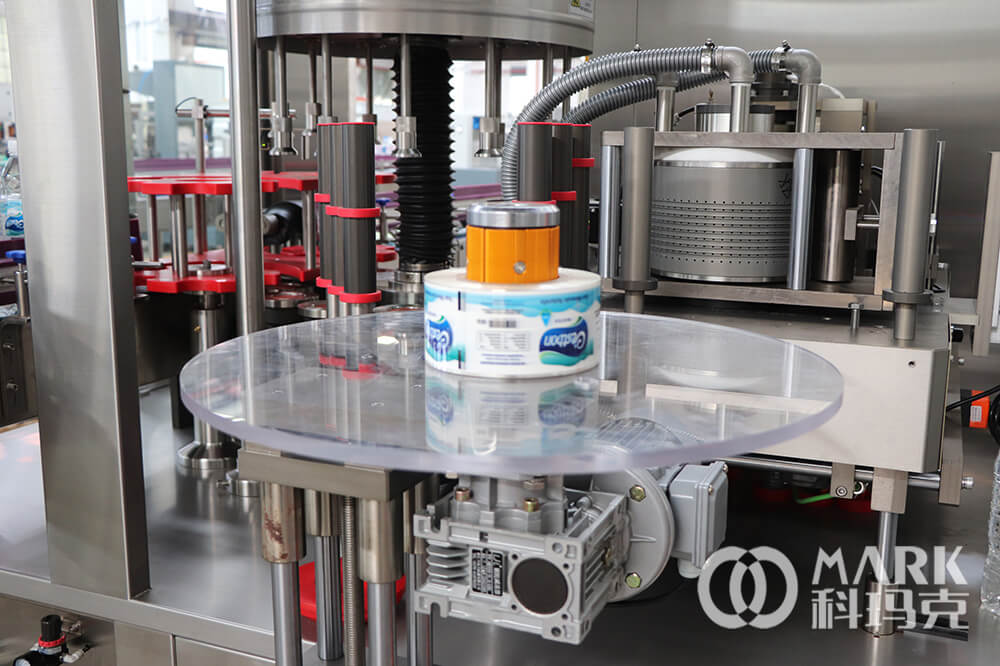
For most small to mid-sized beverage companies, the Adhesive Sticker Labeling Machine is the workhorse of production. These machines require specific parameters to function correctly:
Material Requirement: You must order pressure-sensitive labels on a liner. The liner is typically Glassine or PET, which allows the machine to peel the label off smoothly at high speeds.
Label Orientation (Unwind Direction): When ordering rolls, you must specify the "Unwind Direction" (e.g., Right-Edge Off, Top-Off). This determines how the label feeds out of the machine relative to the bottle. Getting this wrong means your labels will be applied upside down or sideways.
When production hits millions of units, efficiency and 360-degree branding become the priority. At this level, brands move away from simple stickers.
If you see a bottle with a design that covers every curve from cap to base, it was likely applied by a PVC Shrink Sleeve Labeling Machine.
Use Case: Full-body contour coverage allows for maximum marketing real estate.
Material: These machines utilize heat-shrinkable films like PVC (Polyvinyl Chloride) or PETG. Unlike stickers, these sleeves do not use adhesive; they are slipped over the bottle and shrunk tight using a steam or electric tunnel.
For the highest speed lines, such as those used by global soda and water brands, the OPP Hot Melting Glue Labeling Machine is the standard.
Use Case: High-speed beverage lines running tens of thousands of bottles per hour.
Material: This method uses non-adhesive OPP (Oriented Polypropylene) film. The machine cuts the label from a continuous roll and applies a strip of hot melt glue to the bottle and the label overlap.
ROI: While the machinery requires a significant capital expenditure, the material cost is the lowest in the industry because there is no backing liner waste and the film is extremely thin.
The substrate (plastic or paper) is only half the battle. The chemistry holding it to the bottle and the coating protecting the ink are equally vital for shelf appeal.
Not all glues survive the journey from warehouse to fridge.
Acrylic (Permanent): This is the best choice for water bottles. Acrylic adhesives bond stronger over time and are highly resistant to UV light, moisture, and temperature fluctuations. They won't ooze or lose tack in a cooler.
Rubber-Based: These adhesives are generally cheaper and have high initial tack. However, they can yellow with age and may fail (harden and crack) in freezing temperatures. Avoid these for premium water brands.
Wash-Away Adhesives: With a growing focus on sustainability and refillable glass programs, specialized adhesives are available that hold firm during use but dissolve cleanly in hot caustic wash cycles.
An unlaminated label is a vulnerable label. Water bottles are often packed tightly in cases where they rub against each other (vibration friction) and against cardboard.
Essential for Friction: Without a protective layer, the ink will scuff off during shipping. A clear polypropylene laminate provides a physical shield.
UV Varnish: If your water bottles will be sold at outdoor festivals or displayed in bright retail refrigerators, UV light can fade standard inks. A UV varnish acts as sunscreen for your brand colors.
Making the final purchase decision involves balancing unit cost against equipment capabilities. Use this framework to determine your entry point.
Method: DIY Inkjet/Laser on Weatherproof Sheets.
Cost Driver: Ink cartridges and premium sticker paper sheets.
At this stage, your cost per label is high ($0.20–$0.50), but your setup cost is zero. This is ideal for prototyping or one-off events.
Method: Professional Digital Printing (Rolls) + Entry-level Semi-Auto Machine.
Cost Driver: Setup fees and die charges.
Here, you outsource printing to a digital label converter. You gain access to BOPP materials and white ink printing. Investing in a semi-automatic applicator ensures straight placement.
Method: Flexographic Printing + Industrial Application.
Cost Driver: Machinery CAPEX, but lowest unit price.
For mass production, you might utilize an OPP Hot Melting Glue system or PVC Shrink application. The labels cost fractions of a cent, but the machinery investment is substantial.
Will it sit in ice? If yes, you must choose BOPP or Vinyl with a permanent acrylic adhesive. Paper is disqualified.
Is the bottle surface smooth or textured? Ribbed bottles (common in lightweight plastics) reduce the surface area for adhesives. Shrink sleeves are often better for ribbed surfaces.
Will it be applied by hand or machine? If by machine, you must know the roll core size (usually 3 inch) and the unwind direction before ordering labels.
The question "what kind of paper should I use" usually leads to the realization that paper is rarely the right answer for commercial water bottles. Synthetics like BOPP offer the durability required to survive the "ice bucket test" and the friction of distribution. While paper labels have a place in dry, room-temperature environments, they pose a significant risk to brand integrity in the beverage sector.
For most growing brands, the path involves starting with weatherproof laser sheets for prototyping, then quickly moving to roll stock to leverage the speed of labeling automation. Whether you choose pressure-sensitive stickers or full-body shrink sleeves, the goal is a label that stays pristine until the last drop is drunk. Final advice: never commit to a full production run without requesting a material sample kit and performing your own soak test.
A: Generally, no. Regular sticker paper is uncoated and cellulose-based. When it encounters condensation or ice water, it will absorb moisture, wrinkle, and peel off. Additionally, if you print on it with a standard inkjet printer, the ink will bleed. Only use "weatherproof" or "water-resistant" synthetic paper if you must use a paper-like material.
A: BOPP (Polypropylene) is thin, cost-effective, and excellent for high-speed machine application. It is the industry standard for food and beverage. Vinyl is thicker, more flexible, and more durable against UV rays and outdoor elements, but it is typically more expensive and better suited for manual application or heavy-duty industrial stickers.
A: Inkjet ink is water-soluble. To stop smearing, you must seal the print. You can spray the label with a clear acrylic fixative spray (like Krylon) or apply a clear laminate over the top. The easiest DIY laminate is clear packing tape or self-adhesive cold lamination sheets applied after printing.
A: Yes. Standard labeling machines use optical sensors to detect the gap between labels. These sensors "see" the label opacity. Clear labels are invisible to standard sensors, so you need a machine equipped with a capacitive or ultrasonic sensor to detect the thickness change between the label and the liner.
A: It depends on the local facility. PVC generally complicates the recycling process for PET bottles because the two plastics have different densities and melting points. To make a bottle fully recyclable, consumers usually need to remove the shrink sleeve (using a perforation strip) before tossing the bottle in the bin.